

Built for the statutory reality, and for the questions an auditor asks.
None of these are cosmetic. Each one is the difference between an answer and a shrug when somebody asks "who changed this, and when".
Home / Why us
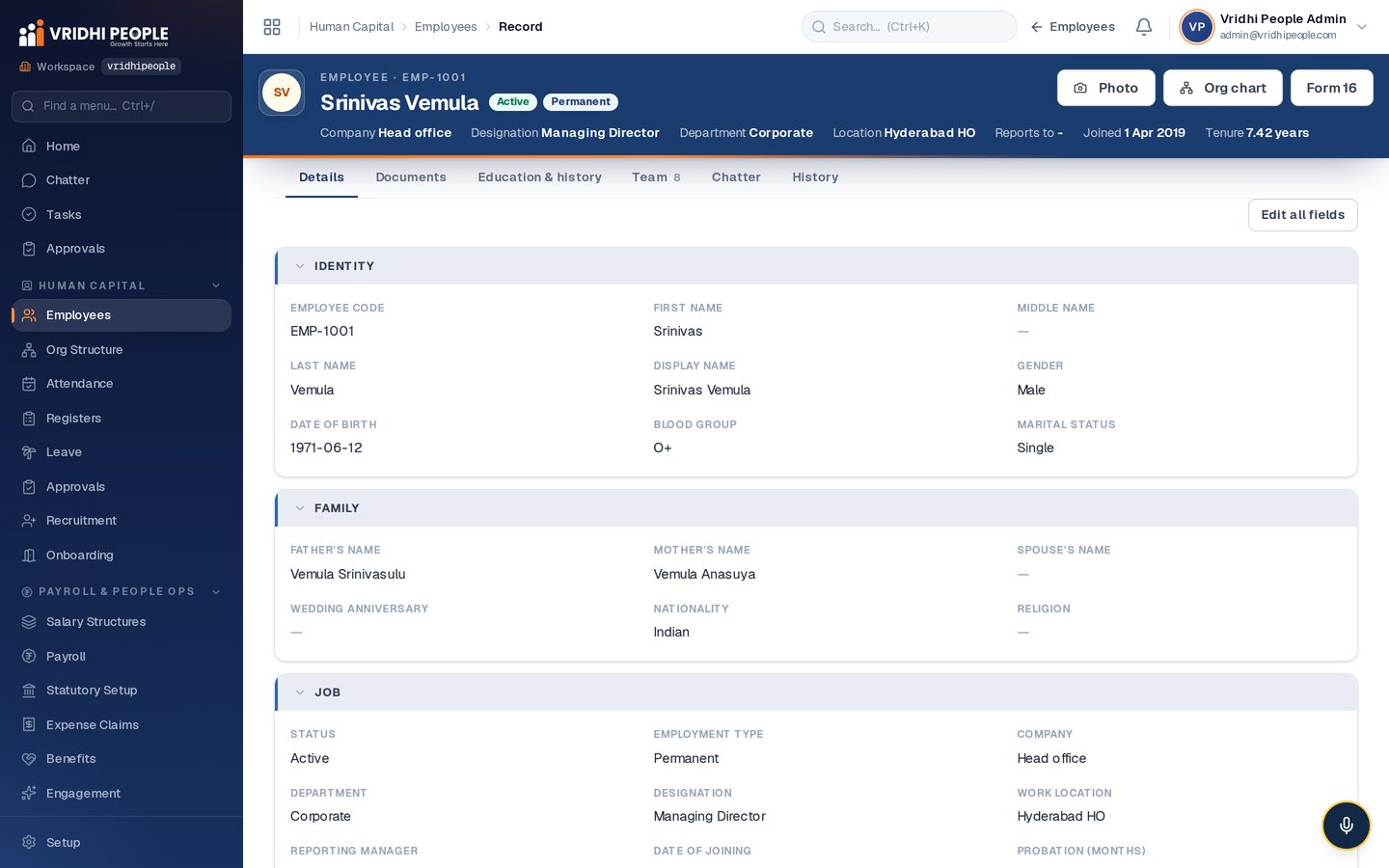
Field-level history on fifty-nine objects, including attendance and recruitment, with who, when and what it was before. The trail is append-only; retention is a setting with a statutory floor.
Leave balances post to a ledger. Final settlements are computed, never typed. Salary structures are sealed by approval and one active salary per person is enforced by the database. Every rupee has a line it came from.
Personal data is masked by role through a response layer, an unmasked view is an audited act, subject requests and breaches have a register. India's 2023 law, handled where the data lives, not in a policy document.
One approval engine for leave, claims, requisitions, offers, salary structures, bonus and payroll release, with criteria, multi-level chains and delegation. The chain is a rule; the approvers are people, snapshotted when the request is made.
Every punch carries its place. Geo-fencing, the office network rule, selfies and regularisation that excuses rather than erases. The manager's punctuality picture means something.
Ask HR, answered by the system: who is absent, who joined this month, what the payroll status is, from the live record with names, not from a report somebody ran last week.
Your tenant, your address, your data.
One tenant per employer
Every employer runs on its own schema and its own web address. Nothing is shared across companies, and a group with several legal entities keeps them apart inside one tenant.
Hosted in India
Servers in India, encrypted in transit, nightly backups. The employee portal and the app have their own logins with one-time codes; the console uses single sign-on.
Roles and sharing
Profiles decide which fields a role may see and edit; sharing rules decide whose records. A manager sees the branch below them and nobody else.